 IT Manager Use Case – Nexus Padel Global
Persona: Alicia – IT Manager – Nexus Padel Global
 Role & Responsibilities
Alicia leads Nexus Padel’s IT & Digital Systems team, overseeing the company’s technology infrastructure, business applications, and digital innovation across 13 cities in Europe and North America. Her responsibilities include:
- Managing core systems like Dynamics 365 F&O (ERP), Dynamics (CRM), e-commerce platforms, and Zendesk (Customer Service)
- Ensuring system uptime, cybersecurity, and data integrity
- Supporting digital transformation initiatives and technology upgrades
- Coordinating with regional IT support hubs (e.g., Montreal, New York, Utrecht)
- Evaluating and implementing new technologies (e.g., AI, IoT, cloud migration)
 Challenges
Nexus Padel is executing over 20 concurrent projects, many of which involve IT systems — from CRM consolidation and e-commerce upgrades to sustainability tracking and acquisition integrations. Alicia’s team is constantly pulled into overlapping initiatives, often without full visibility into:
- Which systems are being touched
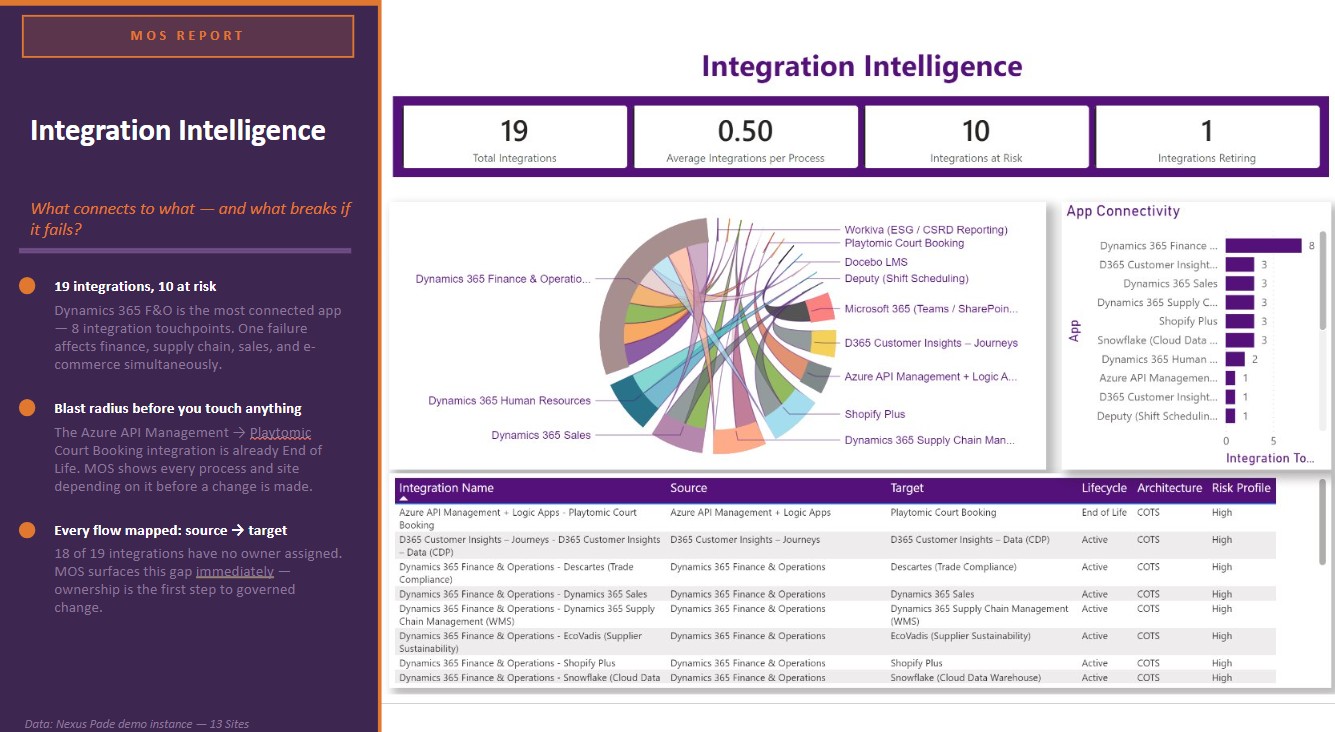
- Where integrations exist
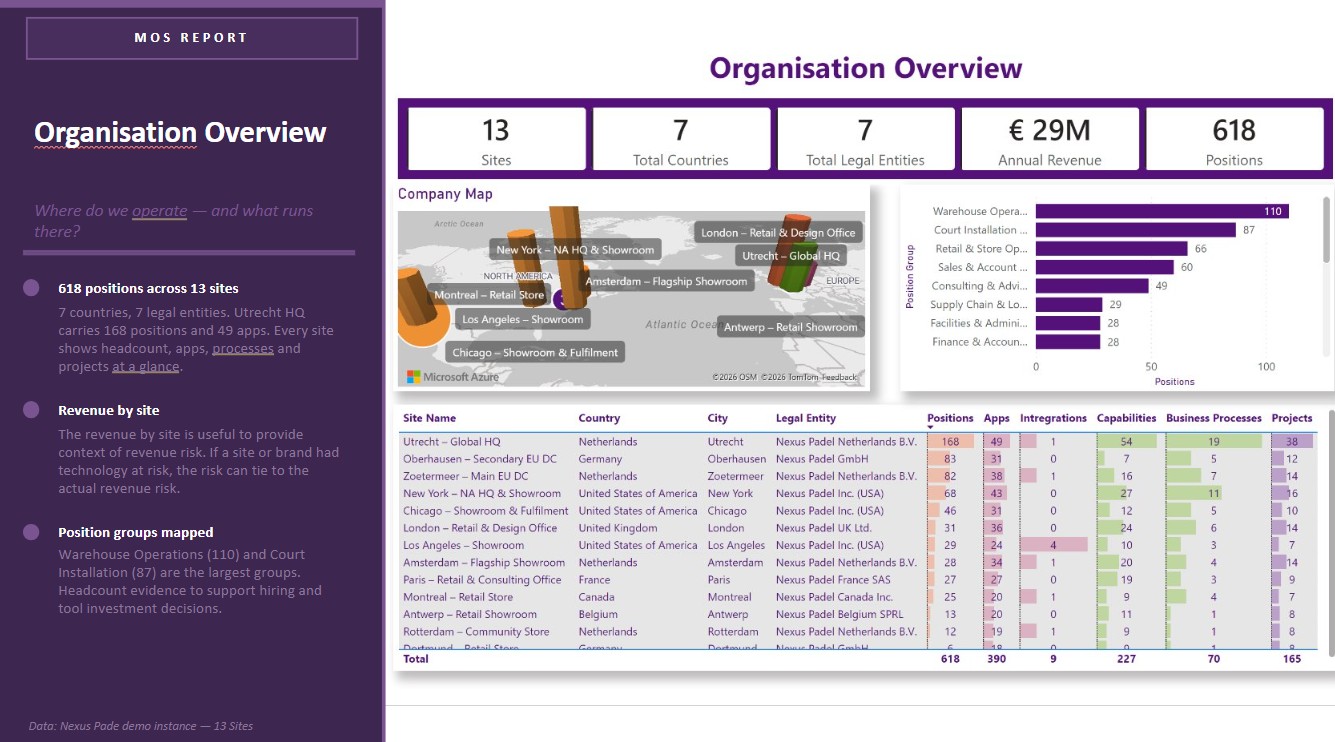
- Which departments or sites rely on which tools
- Whether legacy systems are still in use or can be retired
This lack of clarity increases the risk of downtime, duplicated effort, and missed dependencies — especially during cloud migrations, system decommissions, or vendor transitions.
✅ How MOS Helps
Alicia uses MOS to gain a real-time, structured view of Nexus’s entire technology landscape, including:
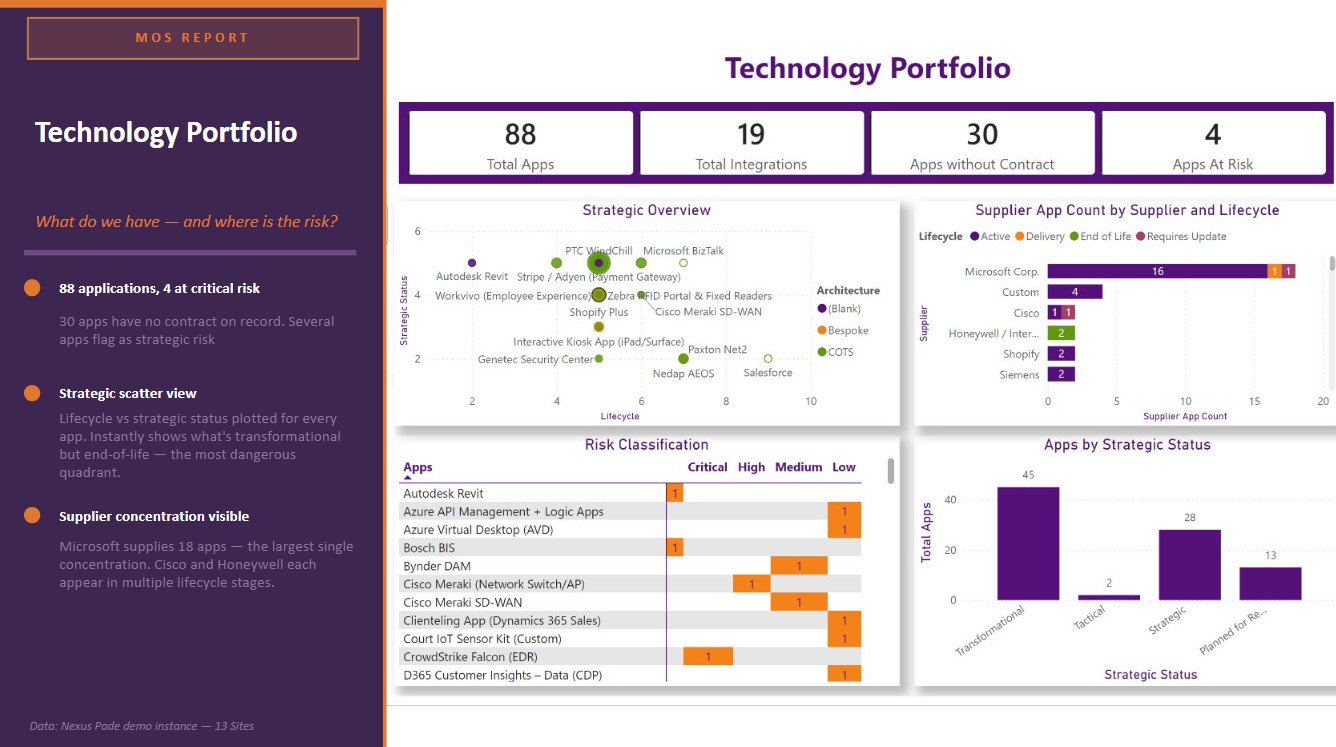
- A full inventory of all applications, integrations, and their associated costs
- Visual maps showing which systems support which business capabilities, processes, and departments
- Project-to-system impact mapping: which initiatives are modifying, replacing, or depending on specific tools
- Identification of redundant or legacy systems (e.g., FinancePro used only in NL, or LegacyPadel CRM still active in North America)
For example, when planning a CRM consolidation, Alicia uses MOS to:
- Identify that both Salesforce and LegacyPadel CRM are active
- See that LegacyPadel CRM is only used by the North America Sales team
- Confirm that Salesforce is already integrated with NDH’s ERP and e-commerce platforms
- Flag the LegacyPadel CRM for decommissioning and plan a phased migration
💡 Outcome
Benefits: Alicia gains complete control and visibility over the technology landscape. This leads to concrete benefits:
- Cost Savings: By identifying redundancies and better allocating resources, the architect can confidently target that 15% reduction (e.g., by retiring duplicate apps or renegotiating licenses after seeing all supplier contracts in one place).
- Risk Reduction: Fewer “surprise” dependencies mean fewer incidents. For instance, avoiding the scenario of unknowingly shutting down a critical integration – MOS’s integration map prevents that by clearly showing all connections.
- Strategic Alignment: The IT strategy aligns better with business needs. MOS links applications to business capabilities and processes, so the architect can ensure that critical business areas are well supported by technology and identify gaps or over-investments. If a capability is vital but MOS shows it’s supported by a patchwork of many small tools, that flags an area for strategic improvement.
- Efficiency: Instead of spending weeks gathering data for decisions, the IT team can retrieve it instantly. This agility means the company can respond faster to market or stakeholder demands, as the IT impact of any proposed change (like adopting a new CRM or merging two departments’ systems) is readily available.
Alicia becomes a strategic enabler of change — not just a support function.
🔄 Keeping MOS Relevant: Alicia’s Role in System Governance
To ensure MOS remains a reliable source of truth, Alicia and her team play a critical role in maintaining the accuracy of technology-related data:
- 🧩 Updating system records when new tools are introduced or retired
- 🔄 Reviewing integration maps and dependencies quarterly
- 🧪 Validating that project metadata (e.g., system impact, timelines) is correctly linked in MOS
- 💬 Collaborating with business owners to confirm which systems support which processes and capabilities
- 💡 Tagging systems with strategic status (e.g., “To Be Retired”, “Core”, “Under Evaluation”)
- By embedding MOS into IT governance routines, Alicia ensures:
- The platform reflects Nexus’s evolving tech stack
- Change impact assessments remain accurate
- Other departments (e.g., Operations, Finance, PMO) can rely on IT data for planning and decision-making
In short, MOS becomes the IT Lead’s go-to knowledge base for technology planning, making the IT landscape transparent and manageable. This not only helps in cost-cutting initiatives but also in future-proofing the enterprise architecture (e.g., planning for scaling, ensuring security by knowing where all data flows are, etc.), all of which keep the business running smoothly and innovating effectively.