 Transformation / PMO Manager Use Case
Persona: Ravi, Transformation Manager – Nexus Padel Global , Amsterdam
 Role & Responsibilities
Ravi leads the Transformation Office at Nexus Padel Global. He owns the end-to-end lifecycle of strategic initiatives — from initial scoping through delivery and post-go-live stabilisation. He works closely with IT, Operations, Finance, and site leadership to ensure that transformation programmes are executed coherently across a complex, multi-entity organisation.
In practice, this means Ravi is the person who has to answer the question no one else can: “If we change this system, process, or team — what else breaks?”
His portfolio at any given moment spans:
- Digital transformation programmes (CRM migrations, ERP upgrades, platform consolidations)
- Post-acquisition technology and process integrations
- New site and country rollouts with localisation requirements
- Operational process redesigns driven by strategic priorities
- Change management and business readiness across all impacted functions
 Challenge
Running a transformation portfolio of this scale sounds manageable in a spreadsheet. In reality, it is anything but. Ravi’s biggest challenge isn’t managing individual projects — it’s understanding how they interact.
Ravi knows which projects are in flight. What he struggles to see — clearly and in real time — is the cumulative impact of everything happening at once:
- Which systems are being touched by multiple projects simultaneously?
- Which teams are absorbing too much change in too short a window?
- Which project dependencies exist that no one has formally documented?
- When a new initiative is proposed, where does it fit — and what does it disrupt?
Without answers to these questions, Ravi cannot give the business the one thing it needs most: confidence that change is being managed, not just tracked.
 How MOS Helps
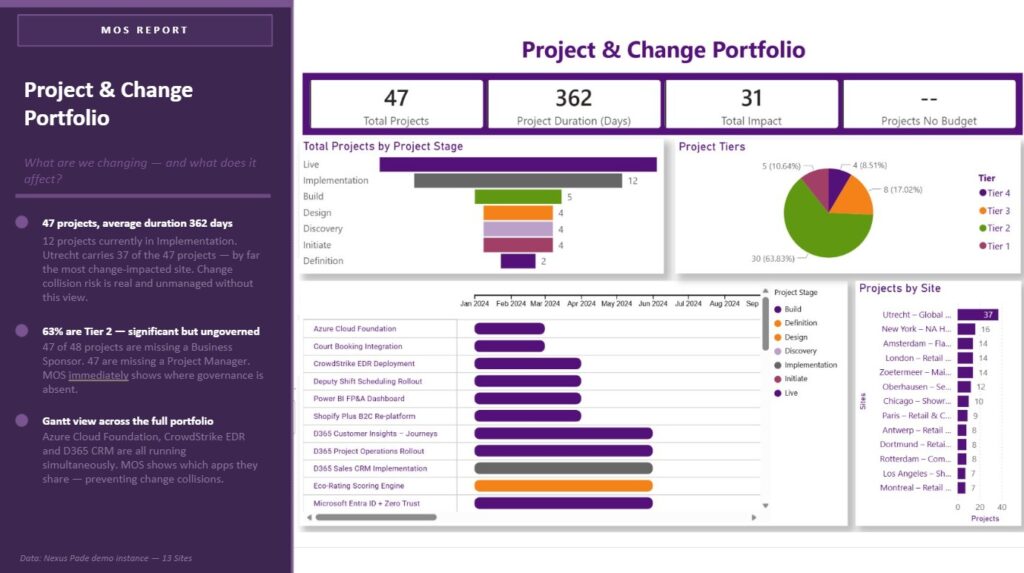
MOS gives Ravi a single, structured view of the entire transformation landscape — not just which projects exist, but how they connect to the systems, teams, capabilities, and sites they affect.
When Ravi opens MOS, he can immediately see:
- Every active and planned project, with linked systems, impacted departments, and go-live timelines
- A visual heat map of which systems are under the most change pressure — and which are approaching overload
- Project interdependencies mapped explicitly — not assumed or buried in email threads
- Site-level change load, so he can flag when Amsterdam, Madrid, or Toronto are carrying too much at once
- Ownership and accountability — which teams and individuals are responsible for each dependency
For example: when a new Retail Experience Platform rollout and a Customer Service Workflow Redesign both target the same Amsterdam site in the same quarter — MOS surfaces that collision before it happens. Ravi can stagger timelines, adjust resourcing, or escalate the decision to leadership — with data, not instinct.
MOS also serves as the shared reference point between Ravi’s PMO and the stakeholders who depend on it. IT, Finance, Operations, and site managers like Luca in Amsterdam all operate from the same source of truth — rather than maintaining parallel, conflicting versions of project reality.
 Outcome
Change load management
Ravi can see which sites, teams, and systems are absorbing too much change — and balance the portfolio accordingly.
Faster impact assessment
When a new project is proposed, assessing its impact on existing systems and initiatives takes minutes, not weeks of stakeholder interviews.
Cross-functional alignment
IT, Finance, site managers, and the PMO all work from a single, maintained source of truth — reducing misalignment and rework.
Executive confidence
Leadership gets accurate, real-time reporting on the transformation portfolio — with the evidence to support decisions on prioritisation and resource allocation.
Post-acquisition readiness
 Operationalize
Ravi didn’t just deploy MOS as a planning tool. He embedded it into how the PMO operates — because a portfolio map that falls out of date is worse than no map at all.
- Every new project is registered in MOS at intake — with systems, sites, timelines, and dependencies documented from day one
- Project metadata is validated at each stage gate, not just at kick-off
- Site managers and business owners are looped in regularly to confirm which processes and teams are genuinely impacted
- Quarterly portfolio reviews use MOS as the live agenda — not a static deck prepared the day before
- Closed projects are properly deregistered, and legacy system decommissions are reflected immediately
The result: Ravi’s PMO is no longer the team that reports what happened. It’s the team that shapes what happens next.